- The FutureProof Advisor Newsletter
- Posts
- Thursday Post: Chronicle
Thursday Post: Chronicle
Happy Thursday,
AI isn’t slowing down—and neither should we. This newsletter is your shortcut to practical ideas and smarter strategies to grow, lead, and adapt as tech reshapes our industry.
To take it one step further, I’ve launched a new YouTube series. Each month, I’m sharing quick, tactical videos showing how advisors can use tools like ChatGPT to save time, think better, and scale more efficiently—starting with the work you're already doing.
Watch my latest episode here
The AI Edge
DISCLAIMER: This video is longer than normal as I decided to do a comparison mid video between Chronicle and another AI tool that we have looked at, Gamma App
AI Application:
Overview:
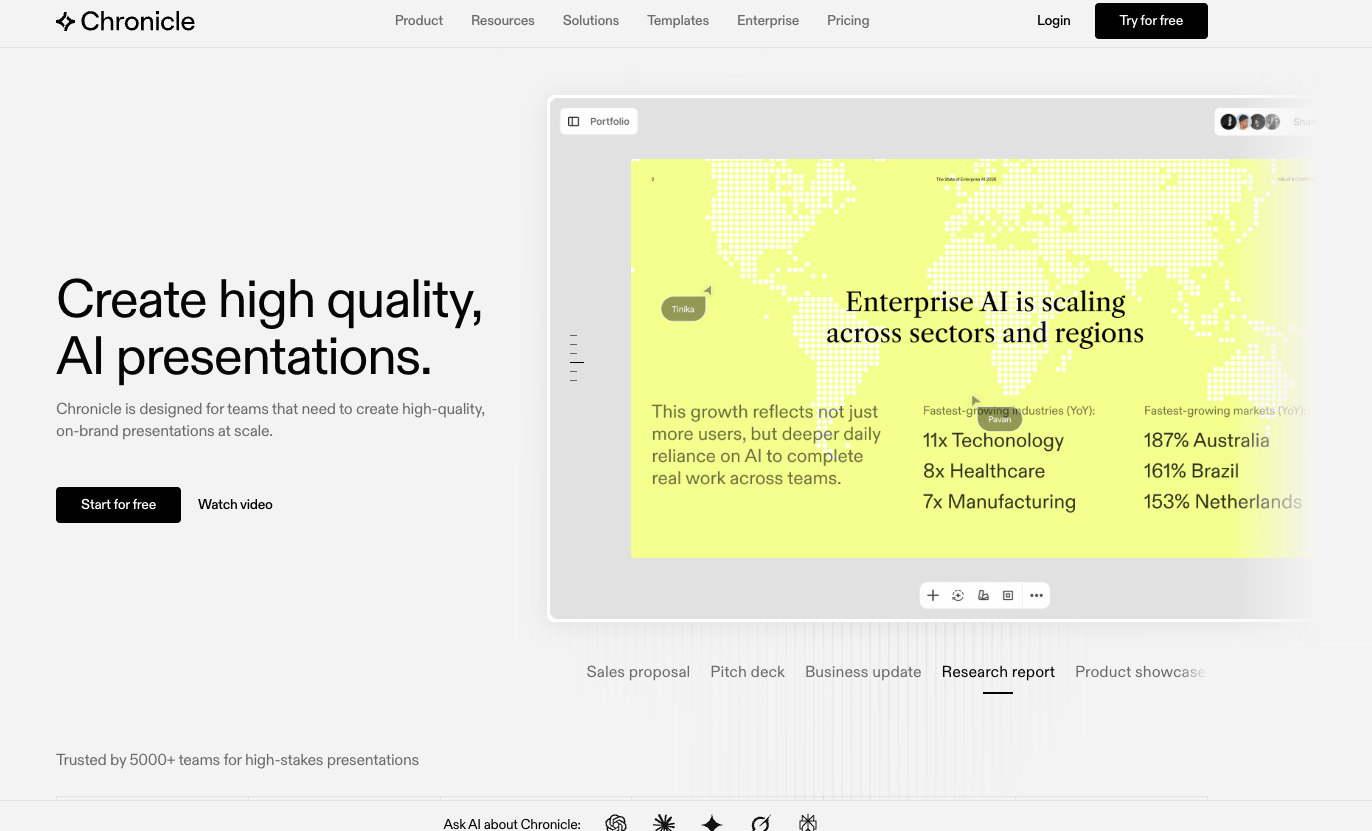
Chronicle is an AI-powered presentation builder. The difference, that caught my eye, between Chronicle and other tools is the slick and minimalist designs they produced. At its core, it takes documents — transcripts, reports, notes — and transforms them into professionally designed slide decks using Claude Sonnet under the hood, tuned specifically for design output.
Users have the ability to use multiple tools and the slide editor is a slick way to easily update and manage each slide to fit your unique need. It’s another tool in the ever growing “suite of AI presentation tools.”
How to apply Chronicle to the business today:
Meeting follow-up decks — Upload a redacted meeting transcript and prompt Chronicle to create a client summary presentation. It handles the structure; you handle the final polish and personalization before sending.
Onboarding summaries — Feed in your onboarding questionnaire notes and create a "here's what we discussed and what comes next" presentation for new clients in the first 30 days.
Annual review prep — Drop in portfolio notes or planning summaries to build the backbone of a review meeting agenda that looks like your team spent hours designing it.
Prospect meeting recaps — After a first meeting with a prospective client, quickly generate a follow-up deck that summarizes their situation, goals, and your preliminary thinking — differentiating you before anyone else sends a standard email.
Team briefing materials — Use it to convert internal notes or strategy updates into clean briefings for junior advisors or client service staff before a meeting.
Advanced:
Build a post-meeting workflow — Pair your AI note-taker (Otter, Fireflies, etc.) with Chronicle to create a semi-automated follow-up pipeline: transcript in, client presentation out, reviewed by an associate before sending. This starts to look like a repeatable system, not a one-off task.
Segment your presentation templates by client tier — Use Chronicle's theme and design customization to develop distinct visual styles for different client segments — a clean, conservative look for your older wealth preservation clients and something more dynamic for younger accumulators.
Integrate into your compliance workflow — Before presentations go out, establish a review checkpoint where Chronicle's output gets reviewed against compliance standards. The structured format actually makes this easier than reviewing free-form email recaps.
Let support staff own this process — Identify a CSA or client service associate who has design sensibility and hand them Chronicle as their tool. They refine and finalize the decks, freeing advisors entirely from the production work while keeping quality high.
Use the storyline feature as a thought organizer — Before you even care about the final slides, use Chronicle's storyline builder as a structured way to think through what a client presentation should cover. Then export or adapt that structure into whatever format you need.
What could this application mean for the future of our business?
Here's what I keep coming back to: advisors do a great job in their meetings. The conversation is substantive, the advice is solid, the relationship is strong. But the client struggles to remember what was discussed when they leave the meeting. Making it hard to communicate to their spouse, adult kids or friends who are genuinely interested or looking for a new advisor. What would help is something they can point to and share.
Right now, the follow-up communication gap is one of the most consistent weak points in firms. The follow up is a text email or a PDF of a 50 page financial plan. I think that Chronicle, and tools like it, point toward a world where the quality of our post-meeting communication can actually match the quality of the conversation itself, without adding hours of production work to your week.
The competitive dynamic here isn't about the tool itself. It's about which firms build systems around it. Imagine a practice where every client meeting generates a consistent, beautiful follow-up within 24 hours. That's not just a nice touch, it starts to change how clients perceive the value they're receiving. It also makes your practice look more like a team operation than a solo act, which matters when you're trying to grow or eventually transition the book.
See Chronicle in action:
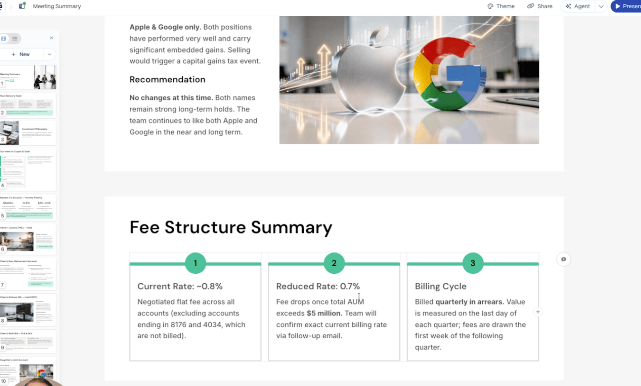
In this demo, I uploaded a real 24-page meeting transcript, redacted of course, and watched Chronicle try to build a client-ready portfolio review deck from scratch. It identified the key discussion points (crypto views, account structure, fee arrangements, action items), built a full storyline before touching design, and flagged on its own that it had anonymized names I'd need to swap back in.
But here's where it gets honest: the first output wasn't good enough. The structure was there, but the slides were too plain. So I ran the same transcript through Gamma, a tool we've covered before, and compared the results side by side. It's the first time I've done a live head-to-head on this channel, and the difference tells you something important about where each tool actually shines. Watch to see which one I'd actually use with a client deck tomorrow.
-Matt
Do you feel that this tool can add value in your business today? |