- The FutureProof Advisor Newsletter
- Posts
- Thursday Post: Opus 4.7
Thursday Post: Opus 4.7
Happy Thursday,
AI isn’t slowing down—and neither should we. This newsletter is your shortcut to practical ideas and smarter strategies to grow, lead, and adapt as tech reshapes our industry.
To take it one step further, I’ve launched a new YouTube series. Each month, I’m sharing quick, tactical videos showing how advisors can use tools like ChatGPT to save time, think better, and scale more efficiently—starting with the work you're already doing.
Watch my latest episode here
The AI Edge
AI Application:
Overview
Claude just launched their most robust model yet, Opus 4.7. So, as would be expected, I had to try it out.
We tend to think of Claude as a place to ask questions or draft emails.
I found it useful as a production tool for some client insights.
Here's the scenario. I had a PDF of an investment committee presentation, one our research team put together for advisors, full of charts, yield curve analysis, market commentary, and closed-end fund mechanics. Dense material. Sophisticated assumptions. Not something you'd email to a client and expect them to read.
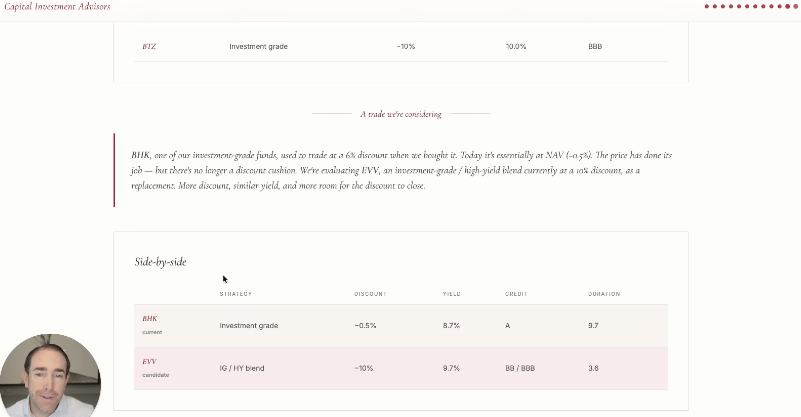
I gave Claude one prompt, spoken, not typed, along with the PDF, and asked it to turn that presentation into an interactive client-facing experience. Something a family could work through at their own pace, with plain-English explanations of every term, contextual charts, and the same takeaways they'd get from a webinar. No coding. No design work. Just a description of what I wanted and an uploaded file.
Two minutes later, I had an HTML file I could open in any browser. Hover over "CPI" — it explains what it means. Click into a section on closed-end fund discounts — it walks through the mechanics with a visual. The entire deck, translated for the people who actually hold the portfolio.
How to apply Claude Opus 4.7 to the business today:
Convert research into client education. Upload any PDF — investment committee notes, market outlooks, fund commentaries — and ask Claude to build a plain-English interactive summary your clients can actually navigate.
Replace the newsletter for complex topics. When the material is too nuanced for bullet points, an interactive HTML experience can do what a newsletter can't: let clients explore at their own depth.
Prep client meeting follow-ups in minutes. After a review call, upload your notes or a deck and have Claude draft a structured follow-up that mirrors what was discussed.
Simplify compliance-heavy documents. Upload a prospectus or ADV section and ask Claude to create a plain-language walkthrough — not for filing purposes, but for your team's internal understanding before client conversations.
Turn advisor-facing content into client-facing content. Anything your research team creates for internal consumption can be reframed for client delivery without starting from scratch.
Advanced:
Build self-paced client onboarding. Upload your onboarding documentation and have Claude generate an interactive walkthrough new clients can complete before their first meeting — reducing the time you spend covering basics in person.
Create a reusable quarterly update template. Establish a standard HTML format once, then swap in each quarter's research PDF and regenerate the client experience with minimal prompt iteration.
Layer in your firm's voice and branding. Claude can incorporate your tone, terminology, and visual preferences into the output — so the interactive experience feels like it came from your team, not a generic tool.
Use it for prospect education. A well-structured interactive piece on a topic like sequence-of-returns risk or alternative income strategies could serve as a lead-gen asset your team emails or posts — without requiring design resources.
Test client comprehension. Ask Claude to add knowledge checks or reflection prompts into the interactive experience so clients can confirm their own understanding before a review call.
What could this application mean for the future of our business?
The bottleneck for most advisory practices isn't knowledge — it's delivery. Your team produces real thinking, real research, real insight. The challenge is packaging it in a way that reaches clients without requiring a live presentation every time.
What this demo points toward is a model where your research output gets two lives: one for your team, one for your clients. The same investment committee deck, analyzed internally and delivered externally — with Claude handling the translation layer between the two audiences. Over time, that changes how clients experience your firm. Instead of periodic newsletters they skim and quarterly calls they half-remember, they can engage with your thinking on their own schedule, in their own way, at the depth that's relevant to them. That's a different kind of relationship.
It also shifts what your associates and junior staff are working on. When an AI handles the reformatting, the plain-English rewriting, and the interactive structure, your people focus on checking, refining, and adding judgment — not producing from scratch. That's a better use of everyone's time, and it scales in a way that hiring alone never will. This isn't about reducing the advisor relationship. It's about extending how far your thinking can reach between those conversations.
See Claude Opus 4.7 in action:
In this demo, I upload a December investment committee PDF, the kind your research team would typically present to advisors, and ask Claude to rebuild it as an interactive client experience. Watch what comes back: a fully navigated, browser-based presentation with hover-over term definitions, contextual charts, and section-by-section breakdowns written for everyday investors.
The prompt took about 30 seconds to dictate. The output took two minutes to generate. And at the end, I'll show you exactly what I'd actually send to families, and why I think it's more valuable than a newsletter.
-Matt
Do you feel that this tool can add value in your business today? |