- The FutureProof Advisor Newsletter
- Posts
- Tuesday Email: Clients want purpose, it’s more meaningful
Tuesday Email: Clients want purpose, it’s more meaningful

Matt Reiner
December 02, 2025
Happy Tuesday!
Every Tuesday I'd like to offer strategies for the week ahead and a thought to fuel your action.
I'll never forget that day one client fired me… and their portfolio was up over each time period analyzed.
I saw his name in my inbox and was excited to read the email.
The excitement quickly dissipated to shock; he was moving to a different advisor.
When I reached out to him to understand why he was leaving, he couldn't pinpoint the reason.
And it was in that moment—those five seconds after hanging up the phone—that changed my perspective on our role.
Here's what nobody tells you about financial advice: the number on the statement is never the real reason someone stays or leaves.
We get angry at portfolio declines during market downturns, but the anger isn't really about the 8% drop. It's about something we can't name—a feeling that the money is moving but our life isn't, that we're checking boxes on a plan without understanding the plot.
If portfolio performance were truly the measure of an advisor's value, then every recession would trigger 100% client turnover. But it doesn't. Something else is at work, something deeper that clients feel but struggle to articulate.
I have become obsessed with understanding this invisible value.
It's this obsession that has led me to stop asking advisors what they think clients want. Instead, I performed a study of 750 affluent Americans—people with over $100K in investable assets who weren't my clients, so they had no reason to tell me what I wanted to hear.
The responses arrived with a clarity that felt almost uncomfortable.
88% said helping with life purpose should be part of a financial advisor's role. Not "nice to have." Should be.
81% wanted an advisor who connects life purpose to financial planning. Among those already working with an advisor, that number jumped to 87%.
But here's the statistic that made me reflect the greatest: 57% of people currently working with an advisor wished they better understood their own life purpose.
They were paying someone to manage their money while quietly desperate to understand why they were making it in the first place.
Bain and Fidelity developed what they call the "Elements of Value Pyramid"—a framework based on Maslow's hierarchy of needs, but for business relationships.
At the foundation: functional elements like saving time, making money, and reducing risk. At the peak: self-transcendence and purpose.
Most financial advisors camp out at the base of this pyramid because it's measurable.
We can point to portfolio returns, tax savings, and estate documents. These elements are like serving edible food—necessary, but insufficient for creating memorable experiences.
The uncomfortable truth: companies that deliver only foundational value are replaceable.
They're the restaurant you can't quite remember the name of, the one where the food was "fine." The higher-order elements of value—the emotional, life-changing, purpose-driven elements—transform transactions into relationships people defend, even when the numbers temporarily disappoint.
But there's a catch, and it's why most advisors never make the climb.
You can't start with purpose. I learned this the hard way.
Early in my career, after reading too many thought-leadership articles, I tried to open client meetings with questions about their deepest values and life meaning.
The discomfort was palpable. One client literally laughed and said, "Can we just talk about my 401k?"
Clients don't initially know they want purpose-based planning because they come to us with surface-level problems: allocate this portfolio, generate income, create a plan for retirement. These are the functional needs, and they're real.
Solving them first isn't settling—it's earning trust.
It's like being invited into someone's home.
First, you knock and state your business at the door. You prove you're competent with the basics —trustworthy with what's visible and concrete.
Only after demonstrating this do you get access to the rooms where real life happens—the conversations about what actually matters, the fears that wake people at 3 am, the dreams they've stopped saying out loud.
The sequence matters: foundation first, then elevation.
Once you've earned that access, your role transforms.
Financial decisions feel disconnected to clients because they happen at different times, in different contexts.
The home purchase. The job change. The inheritance. The college funding. The retirement account adjustment.
Each one is a scene, but without a narrative thread connecting them, they're just isolated events that create anxiety rather than meaning.
Your job becomes a film editor.
You take the scattered footage of a client's financial life and help them see the through-line.
You show them how the decision to buy less house than they could afford in their 30s is connected to the ability to work part-time in their 50s to care for aging parents. How the decision to fund their daughter's education without loans connects to their parents' sacrifice a generation earlier. How each financial decision is actually a values decision in disguise.
This is narrative identity—helping clients see themselves as the protagonist of a coherent story rather than a passive participant in random events.
When a client looks at their financial plan and sees their life story reflected in it, something shifts.
The plan stops being a document their advisor updates annually and becomes their story —one they're actively authoring.
Most advisors motivate clients through fear.
We call it "controlled motivation," though it feels more like showing someone the scary cliff edge and hoping they step back.
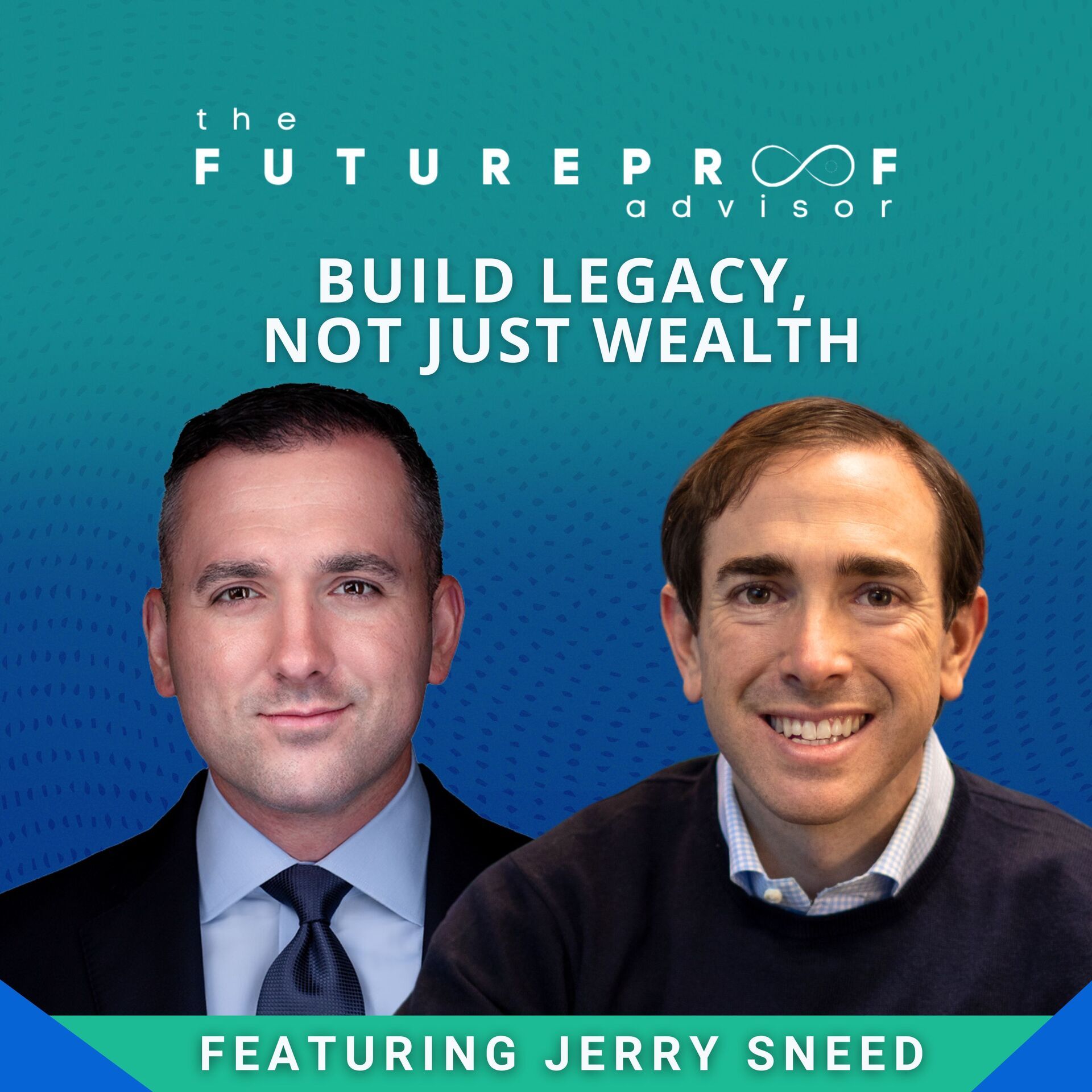 | Build Legacy, Not Just WealthSome lessons don’t come from data—they come from listening. This conversation with Jerry Sneed unpacks how the best advisors lead not with answers, but with curiosity—and how intentional, values-based conversations can unlock the very clarity clients are quietly searching for. It’s a timely reminder that our most enduring impact doesn’t come from the plan—it comes from the questions we’re bold enough to ask. |
We present the cash flow analysis that shows them running out of money at 85.
We stress-test portfolios under worst-case scenarios.
We use terms like "shortfall," "gap," and "risk."
And it works—temporarily. They take the action we recommend.
But controlled motivation is exhausting for everyone involved. It requires constant external pressure.
The client never fully owns the decision because they made it to avoid a negative outcome, not to move toward something they actually want.
Autonomous motivation is different.
It comes from intrinsic values aligned with a broader sense of purpose. It's the difference between exercising because your doctor showed you scary statistics versus exercising because you've discovered you want to be the grandparent who can still hike with grandkids at 75.
When clients understand their purpose and see how their financial decisions serve that purpose, motivation becomes self-sustaining.
They don't need you to manufacture urgency. They're not following your plan—they're executing their story.
This is the shift: from advisor as enforcer to advisor as guide in a journey the client actually wants to take.
When I think about our industry in five years, AI is obviously part of the picture. It will optimize portfolios, automate rebalancing, identify tax-loss-harvesting opportunities, and maybe even generate decent financial plans.
But here's what keeps me optimistic, not anxious: AI will struggle with the one thing humans are wired to need—genuine human connection.
People might form attachments to AI assistants.
But there's something about sitting across from another person who looks you in the eye and says, "I see you struggling with this decision, and here's what I'm noticing "—something about being known by another human—that technology will find difficult to replicate.
Our moat against disruption isn't superior investment strategies or more sophisticated planning software.
It's the relationship itself. The connection that makes a client stay even when the portfolio is down, that makes them refer their friends, not because of returns, but because "you just have to meet my advisor."
We've been handed the ultimate competitive advantage.
The question is whether we'll develop it or keep defaulting to what's easy to measure.
That client who fired me? I always wished I had run into him again to see how the decision turned out for him.
But now, I don't wish that; I have a strong belief about what he would say, and it would be that I didn't get to know what he wanted to do with the wealth we were creating together.
And if I were to run into him, I'd say "thank you." Because it was he who led me down this path that will forever alter, for the positive, how I view serving clients.
The data confirms what he already knew: clients are asking for this deeper level of service. They're not just willing to pay for purpose-based planning—they're actively wanting it, sometimes desperately.
The infrastructure of our industry was built around portfolio management because that was the easiest to see and measure. But just because something is measurable doesn't mean it's meaningful.
The opportunity isn't to abandon the foundation—portfolio management, financial planning, risk management. It's to see those as the entry point, not the destination.
Your clients aren't portfolios that happen to have people attached.
They're people with purposes, trying to figure out how money fits into lives they're still learning how to live.
The question isn't whether AI will change financial advice. It will.
The question is whether we'll deepen the one thing machines can't copy—the human relationship that transforms numbers into meaning.
The best is ahead!
-Matt
What's your biggest challenge in moving beyond portfolio management with clients? |